





Don’t NEGLECT your Chimney!
Roofing materials naturally deteriorate with age, and consequently become less effective at keeping water out. Temperature fluctuations and weather conditions certainly are the primary additional factor that cause roofing materials to become brittle and crack over time. Chimney stacks can be the most problematic structural part of any roof and are responsible for many of all reported leaks into our homes. The main reason for this, quite simply, is the fact the chimney stacks are the highest point of the roof structure, and consequently are wide open to the elements.


Most chimney stacks are often almost forgotten about, and certainly not intentionally, but merely because it is generally a part of our home that we naturally assume to be doing its job, and the fact it is the highest and most distant part of the roofing structure. That then changes dramatically once a problem arises. The most commonly reported issues with chimney stacks are the natural eroding of the pointing, which is visible when the ‘jointing’ between the courses of bricks, or stonework, is no longer flush with the brickwork due to it breaking away. Where the mortar mix holding the courses together once was, which is identifiable by the colour of the mortar, you will notice an almost black void, indicating a recess, and a problem that would need to be addressed. And sooner rather than later.
Although this may not sound too serious, but if those signs are ignored, this will most certainly hasten the onset of more serious problems, which could even result in structural issues. A chimney stack that isn’t periodically checked, or maintained, becomes a neglected chimney stack, and that can be an accident just waiting to happen. Also, the size of the chimney stack can relate directly to the size of the problems you could potentially incur. So be careful and try to monitor your chimney stack, bi-annually as a rule, or after heavy storms and high winds.
The most common problems that can arise from a neglected chimney stack are water penetration, which can lead to more serious issues such as instability, and in worst cases, even disintegration.
To help prevent the more serious issues, if caught in time, all that may be required, would be professional re-pointing works, from an accredited contractor. A cheap and cheerful patch and point repointing job maybe all you require or can afford but be aware that this has a very limited life-span and is simply a short-term fix. Repointing over old mortar with new mortar will never retain a secure fix and will most certainly fall back out of the joints, leaving you with the same problem again, and more money to spend.
If a job is worth doing, it’s worth doing right, or you pay cheap and you’ll invariably pay twice.
My chimney started crumbling last winter during high winds, so I called Lord Roofing to fix it for me. They did a fantastic job, with all work completed at an excellent price!
Tom Richards, Ferryhill
The professional and correct process of re-pointing a standard brick chimney stack is to grind out between 15-25mm of the failing mortar joints around all four faces of the stack, this is to ensure all failed mortar is removed to a consistent depth. The chimney stack joints are then cleared of any remaining mortar dust and debris, before the re-pointing can commence.
The next step is very important, which is creating the strongest, most durable and effective mortar mix. This is to ensure that once the chimney stack is fully re-pointed, the life-span is at its optimum level. We can’t control the weather and natural elements, but we can do everything we can to ensure maximum longevity.
LORD Roofing and Grounds Works employ only the very highest level of tradesman, who are specialists within their chosen field. We use a 3-1 mix of sand/cement and water, with an addition of PVA glue for an extra bond, as well as plasticizers when temperatures are below are certain level. This ensures the mix bonds correctly and cold weather is negated from compromising the mortar bonding and prevents fracturing. The final Master Slater/Re-pointer’s old-school trick is to add a touch of Fairy Liquid into the mix to ensure the smoothest finish possible, and helps when cleaning down the joints, due to the fact it slows down the hardening process of the mortar mix.

In certain cases, a 4-1-1 lime mortar mix maybe required, this will be left to our Master Re-pointers discretion to ensure the most comprehensive and relevant requirements for each individual project.
Finally, a very mild-chemical clean-down would be administered, if required, to complete the perfect, textbook finish.
In unfortunate circumstances, where a chimney stack has been severely neglected and the bricks have badly deteriorated because of water ingress making its way into the internal structure of the chimney stack, via the recesses left from the missing mortar. Then the only option left is to re-build the stack or drop it to below roof level if it’s no longer required. Then felt, re-lath and re-tile over the void that was left. Which is obviously a much more expensive option.

A chimney stack has two common problems that can result in water ingress into your home if they have not been maintained. The first being the pointing issue and the second relates to the flashings that surround the stack to ensure it remains water-tight. If the pointing is integrally sound, then it is highly likely the flashings have failed.
Identifying the problem
Damp patches on walls, ceilings, lime salts on the face of the internal chimney breast brickwork within the loft space. And the chimney breasts below – usually evident as brown staining – are signs of a leak around the chimney stack.
Causes and implications
Over time, persistent dampness can result in fungal decay developing in adjacent roof timbers and can also cause ceilings to bow and eventually collapse.
The most likely cause of damp is defective flashings at the junction with the roof, especially to hidden ‘back gutters’ (the flashings at the back of chimneys on the roof slope — the side you can’t see).
Mortar fillet flashings are sometimes applied as a cheap, short-life alternative to lead, but they’re brittle and prone to cracking. They’re always best replaced with new Code 4 leadwork.

Sometimes, rain can get around an otherwise perfectly good flashing because stacks on older homes don’t have a damp-proof course (DPC); modern brick stacks have a DPC of around 150mm above roof level. Without a DPC, water can soak into porous stack masonry and leach downwards into the loft or rooms below. Damp penetration may also be due to eroded mortar joints or damaged brickwork.
Defective flashings should always be replaced with new lead (this should be of a minimum Code 4 thickness). It’s false economy to use cheaper, short-life materials. At LORD Roofing and Ground Works our Master Roofers and leadwork specialists are masters of their craft, producing extremely high-level works for every type of lead-based work-scopes. Including lead-welding for National Heritage Listed buildings. All lead works come with a LORD Roofing and Ground Works 10-Year Insurance-backed warranty, with a potential life expectancy of over 75 years.
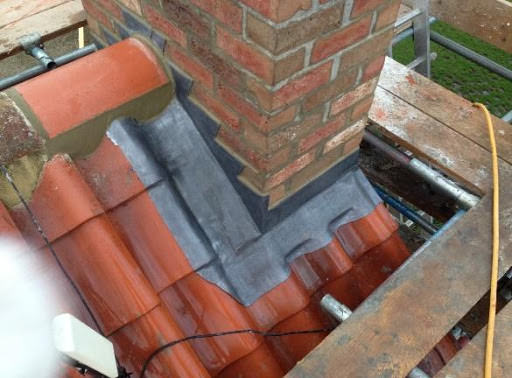
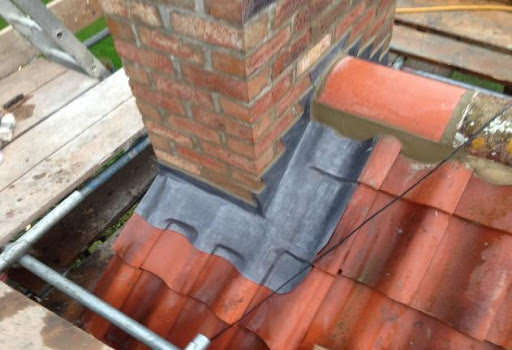


To fit a new lead flashing system to a defective chimney stack, (pan, skirt and side-stepping) LORD’s Master Roofer will cut a groove/chase in the chimney (usually into a mortar joint) approximately 150mm above the level of the roof; on a slope this is normally in a stepped pattern. They will turn the lead flashing at least 25mm into the groove and fix it in place with lead wedges and then seal it with a strong 3-1 mortar mix, or Leadmate when relevant.
It’s worth noting that, traditionally, at the sides of a stack, slates and plain tiles have strips of L-shaped lead ‘soakers’ inserted underneath before being covered with the flashing. Soakers are not necessary with interlocking tiles.
In some instances, the existing flashing may simply have come loose or is inadequately sealed to the brickwork, in which case it may just need to be re-sealed with Leadmate. Where damp is due to porous stack walls that lack a DPC, the problem can sometimes be solved by repointing eroded mortar joints. If all else fails, we would professionally supply, fit and secure new lead flashings that extend higher up and deeper into the brickwork.
OUR PROMISE
The ‘LORD Company Promise’ to our clients is:
"To deliver the very highest quality of customer service, workmanship, and standard of products, for the very best price possible."
Honesty – Affordability – Quality – Integrity – Trust
We will never be beaten on price, on a like-for-like basis.
Welcome to the family of LORD Roofing and Grounds Works Ltd.
Achieving Excellence through Experience by Analysing and Redefining...



Contact Lord Roofing & Grounds Works
Contact us today if you would like a quote for any of the building and roofing services we provide. By calling us today you can speak to a member of our team and ask us any questions you have about the North East roofer services we offer.
Contact Details
Lord Roofing and Grounds Works Ltd
Unit 1BDean And Chapter Industrial Estate
Ferryhill
County Durham
DL17 8LH Head Office: 01740 655444
Durham: 0191 3002398
Darlington: 01325 521370
Newcastle: 0191 406 1724
Teesside: 01642 927151
Stockton on Tees: 01642 927149
Sunderland: 0191 5001582
Newton Aycliffe: 01325 521499
Yarm: 01642 927151
Barnard Castle: 01833 601000
Bamburgh 01668 264002
Morpeth: 01670 331371
Alnwick: 01665 664027
Wooler: 01668 264003
Cramlington: 01670 331371
Ponteland: 0191 406 1724 Email: enquiries@lordroofing.co.uk

Areas


Copyright © 2018 | Website Designed By Outrank